
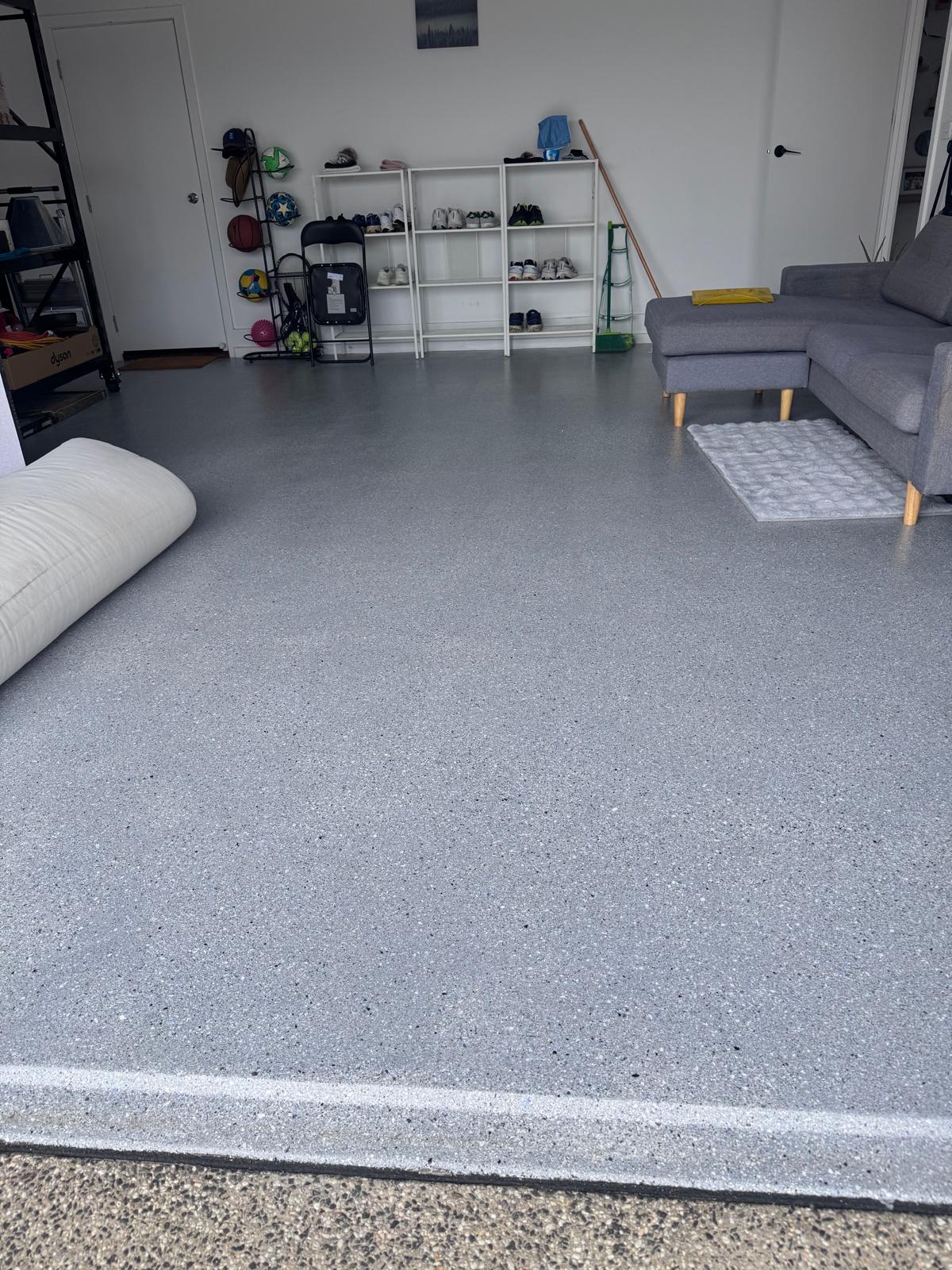
Quick answer: Epoxy is the proven, budget-friendly choice for most Geelong garages and workshops. Polyaspartic cures faster and holds its colour in strong sunlight, but it costs more and is fussier to apply. For many floors the best result is a hybrid: an epoxy base for strength and bond, with a polyaspartic topcoat for UV protection and a faster turnaround.
A bloke in Belmont rings on a Monday.
He has a double garage, a ute that needs to be back inside by Friday, and a mate who swears polyaspartic is “the new thing, done in a day”.
Is his mate right? Partly. And that “partly” is exactly why this guide exists.
What is the actual difference?
Both are two-part coatings. You mix a resin with a hardener, spread it over a ground slab, and it cures into a tough, sealed surface. The difference is the chemistry, and the chemistry changes how the floor behaves.
Epoxy has been the standard for decades. It bonds hard to concrete, builds thickness well and gives you a long working time, which helps on bigger or more detailed jobs.
Polyaspartic is a newer relative of polyurethane. It cures much faster, stays clear and stable under UV, and gives you a very hard wearing surface. The catch is that it sets quickly, so there is less time to fix mistakes.
Polyaspartic vs epoxy: side by side
- Cure time. Polyaspartic is the faster of the two, which can mean getting back into the garage sooner. Epoxy takes longer, so plan for more days without the space.
- Sunlight. Polyaspartic resists UV and stays clear. Standard epoxy can slowly yellow if the garage door is open to strong sun every day.
- Working time. Epoxy gives the installer more time to work the product. Polyaspartic has a short pot life, so it needs an experienced crew.
- Cost. Epoxy is the more affordable of the two. A polyaspartic topcoat typically adds roughly $5 to $15 per square metre over a standard epoxy topcoat.
- Durability. Both handle cars, tools and daily use well when the slab is prepared properly. Polyaspartic is generally harder wearing on the surface.
- Bond to the slab. Epoxy is still the go-to for the base layer, because it grips concrete and fills small imperfections well.
Where epoxy is the smarter pick
If the garage is mostly shaded, used for parking and storage, and you want a great floor without paying for extras, epoxy or a flake system does the job beautifully. It is also the safer choice on larger floors and detailed finishes, where the longer working time helps get a clean result.
Our flake flooring is a good example. It starts with epoxy, adds decorative flakes for colour and grip, then gets sealed. Typical pricing sits around $60 to $110 per square metre. For the full breakdown see the epoxy flooring cost guide.

Where polyaspartic earns its price
- Sun-facing floors. Open garage doors, sunrooms, alfresco areas and covered patios where UV does the damage.
- Tight deadlines. A shop, cafe or workshop that cannot stay shut for long.
- Cooler days. Geelong winters can slow epoxy down. Polyaspartic copes better with cold, which makes scheduling easier.
- High wear surfaces. A tougher topcoat helps in busy commercial spaces. Our industrial floor coatings guide covers what heavy use does to a floor.
The hybrid option most people end up with
This is the part nobody mentions in the pub.
You do not have to pick one. A common professional system uses an epoxy base for bond and body, then a polyaspartic topcoat for UV stability and a harder surface. You get the strength of epoxy and the sun resistance of polyaspartic, for a modest step up in price rather than a full one.
The thing that matters more than either product
Here is the honest truth. Neither coating will save a badly prepared slab.
Almost every failure we see traces back to the concrete, not the resin. Weak surface, oil in the slab, moisture coming up from below. Polyaspartic is actually less forgiving of damp slabs, because the fast cure can trap moisture and cause bubbles.
That is why every job starts with diamond grinding. If a floor has already lifted, read why epoxy floors peel and bubble. And if you are tempted by a hardware store kit, here is what goes wrong with DIY.
How to decide in two minutes
- Mostly shaded garage and a sensible budget? Epoxy or flake.
- Lots of direct sun or a floor you want to stay crystal clear? Polyaspartic topcoat.
- Need it done fast, or working in cold weather? Ask about polyaspartic.
- Want the best of both? Epoxy base with a polyaspartic topcoat.
- Not sure? Let us look at the slab first. The right answer depends on the concrete, the light and how you use the space.
Frequently asked questions
Is polyaspartic better than epoxy?
Not automatically. Polyaspartic wins on UV stability and cure speed. Epoxy wins on cost, working time and bond to concrete. The right choice depends on the space.
Does polyaspartic cost more than epoxy?
Yes. As a rough guide, a polyaspartic topcoat adds about $5 to $15 per square metre over a standard epoxy topcoat. We will give you the exact difference in your quote.
Will epoxy turn yellow in the sun?
Standard epoxy can slowly yellow with constant direct sunlight. A UV-stable topcoat, such as polyaspartic, prevents this.
How soon can I use the floor after coating?
It depends on the system. Faster curing topcoats usually mean an earlier return to the space, but foot traffic always comes back before vehicles. We will confirm the timeline for your job.
Can polyaspartic go over an existing epoxy floor?
Sometimes, if the old coating is sound and properly prepared. Read can you epoxy over an existing coating for what we check first.
How long will it last?
With proper prep, professionally installed floors commonly last 10 to 20 years. See the lifespan guide.
Not sure which one suits your floor?
Tell us the size of the space, how much sun it gets and how you use it. We will give you a straight answer on the right system and a clear price. No pressure.
Call Joe on 0433 249 998 or request a quote below.
Your quote request has been received.
Our team will get back to you shortly.